
Buffer cylinder for an air source heat pump: when it is really necessary
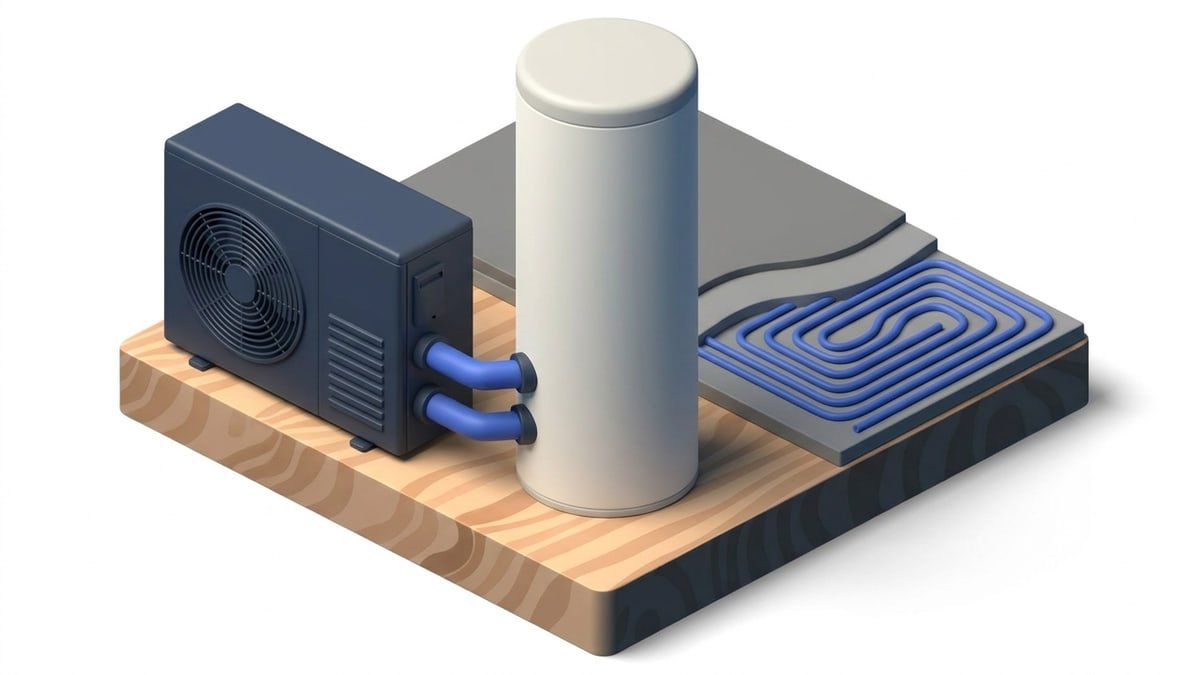
A buffer cylinder is not a mandatory part of an air source heat pump, but it is not nonsense either. Whether it is useful in your house depends on a few points: what type of device is offered, how many heating circuits there are, how the heat is distributed and controlled in the house, and what the manufacturer requires for defrosting and minimum flow rate. For a detached house with underfloor heating and a speed-controlled device, the answer is often: no. If your installer insists on it anyway, they should be able to tell you the reason.
What the expert bodies say about it
The klimaaktiv Wegweiser zur guten Installation von Wärmepumpen (guide to good heat pump installation) is quite clear here. In a detached or semi-detached house, a heating cylinder is therefore usually dispensable. The guide mentions the system hydraulics, such as several mixer groups, and blocking times of the electricity supplier as possible reasons for a cylinder. The industry association Wärmepumpe Austria also writes in its brochure for installers that a buffer is often not needed at all.
The reason lies in the floor: the screed of an underfloor heating system holds a lot of heat itself. According to klimaaktiv, one square metre of underfloor heating corresponds to about 10 Liter of water as a store, calculated with a 5 K temperature difference. Over the entire heated area, this adds up to significantly more storage mass than a standard buffer in the basement offers.
When a buffer actually helps
On/off devices. Some heat pumps only know full power or standstill. So that they do not constantly switch on and off (cycling), klimaaktiv provides for a sufficiently large cylinder for such devices. Speed-controlled devices, often called inverters, adapt their output to the demand. According to the guide, they are clearly more efficient and usually manage without a cylinder.
Multiple heating circuits with mixers. If you have underfloor heating downstairs and radiators upstairs, for example, each circuit needs a different temperature. Then a buffer hydraulically separates the heat pump from the heating circuits. Manufacturer instructions often prescribe a buffer for this case, but usually not for a suitably designed surface heating system.
Minimum flow rate and defrosting. An air source heat pump must repeatedly clear its evaporator of frost in winter. It takes the heat for this from the heating water. Without a buffer, enough water must therefore flow through the heating system and be contained in it. Every manufacturer specifies a minimum flow rate and a minimum water content in the permanently open heating circuits in their instructions, and the values differ from device to device. It is important that someone has recalculated them for your system.
Individual room control. If actuators close in many rooms at the same time, the flow rate can drop below the minimum. According to Wärmepumpe Austria, with correctly designed heating circuits, you can often do without individual room control. Such interventions actually increase the temperature spread and flow temperature and reduce the seasonal performance factor. If the circuits remain open, the buffer can often also be omitted with underfloor heating.
Blocking times and cooling. If your heat pump tariff has blocking times, a cylinder can bridge them. Often the screed alone can manage this. If you want to cool via fan coils in summer, manufacturer instructions often require a buffer, but usually not for cooling via underfloor heating.
What a buffer costs, including in operation
A cylinder is not free, and not just when purchasing it.
- Heat losses: Every tank gives off heat to the installation room, even if it is well insulated.
- Additional pump: If the buffer is installed as a separation, the heating circuit usually needs its own circulation pump, which also consumes electricity.
- Higher temperature: If the buffer is run warmer than the heating system needs, the heat pump has to provide a higher temperature lift. klimaaktiv therefore requires the excess temperature of the cylinder to be kept as low as possible. According to the Energieagentur Tirol (Tyrolean Energy Agency), every degree less in flow temperature saves 2 % energy; values below 40 °C are ideal.
- Money and space: Cylinder, piping, installation and floor space are added to this.
What questions you should ask the installer
- Is the offered device speed-controlled or an on/off device?
- What minimum flow rate and minimum water content does the manufacturer require, and can my heating system manage that without a buffer?
- Where does the energy for defrosting come from if no buffer is installed?
- How many heating circuits and mixers does my house really need?
- How is the buffer integrated, and how much warmer than the heating circuit is it operated?
- Was the heating load calculated according to ÖNORM EN 12831? According to a klimaaktiv brochure on planning heat pumps, heating systems are often too large, and an oversized unit is more likely to cycle. Wärmepumpe Austria explicitly names incorrect sizing as a cause for cycling.
- What does the option without a buffer cost in comparison?
A buffer with a solid justification is not a mistake. A buffer that is only included in the quote out of habit deserves a question. Our guide to checking quotes shows you how to go through a quote point by point. You can get a first assessment of your heating load with the heating load calculator. And if you want comparative quotes: via our request for quotes, you will receive quotes from up to three checked installers, free of charge and without obligation.
AO
This article contextualises a topic that many people are currently talking about. It reflects our assessment and is not a news report. We will continue to think about the topic and update the article if anything new arises.
Sources
- klimaaktiv guide to the good installation of heat pumps — accessed on 29 September 2026
- Wärmepumpe Austria: compact heat pump, info brochure for installers — accessed on 29 September 2026
- Energieagentur Tirol: heat pump — accessed on 29 September 2026
- klimaaktiv: How your heat pump runs smoothly (Energieinstitut Vorarlberg et al.) — accessed on 29 September 2026
We state facts in our own words and link to the source. The mentioned authority itself is always legally binding — public subsidy conditions can change at short notice.