
R32 heat pumps from 2027: What the new refrigerant rules mean
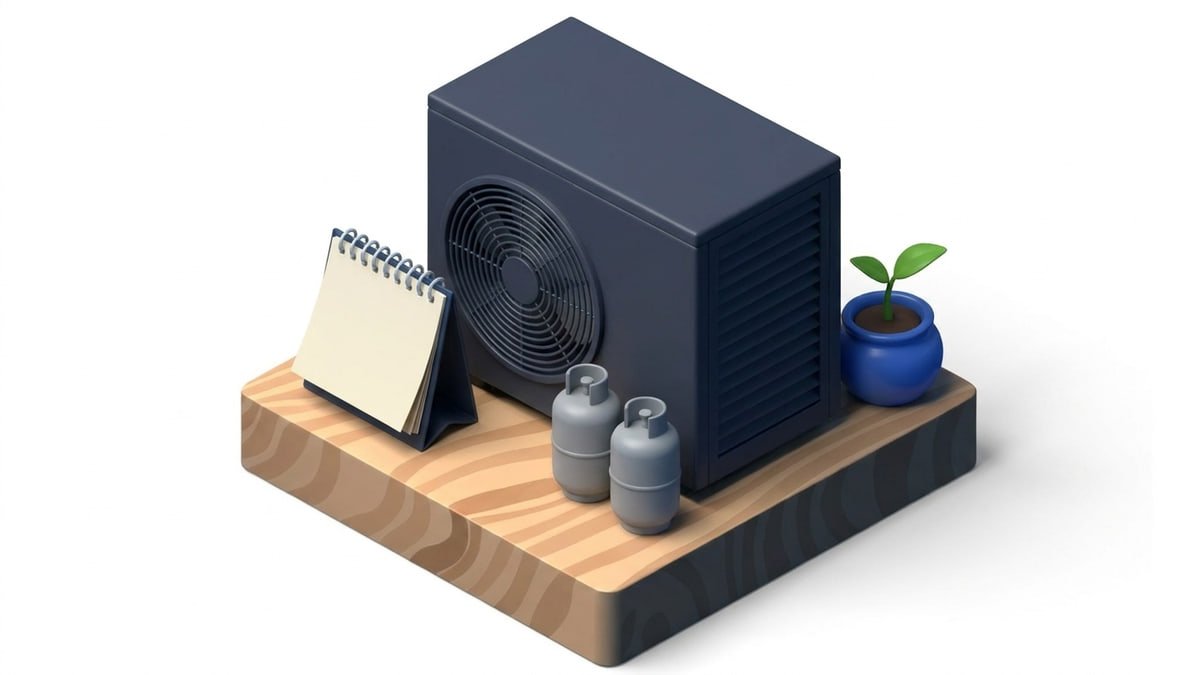
Anyone currently comparing quotes for a heat pump will come across a question that concerns many people: Will I still be allowed to buy an R32 unit in 2027, and what happens to my system that is already running? The short answer: for most new air-to-water heat pumps in detached houses, R32 is over as of 1 January 2027. However, existing systems are allowed to keep running and be serviced, and units that were placed on the market before the deadline can still be installed.
What changes on 1 January 2027
The basis is the EU Regulation on fluorinated greenhouse gases (2024/573). In Annex IV, it gradually bans new appliances containing climate-harmful refrigerants from being placed on the market. The measure is the global warming potential, or GWP for short. According to the regulation, R32 used in many heat pumps has a GWP of 675, while propane (R290) has a GWP of 0.02.
From 2027, the following applies to newly marketed units:
- Monobloc heat pumps (the entire refrigerant circuit is fully pre-filled in a single housing) up to 50 kW maximum rated capacity: no more F-gas with a GWP of 150 or higher.
- Air-to-water split units up to 12 kW: likewise no more F-gas with a GWP of 150 or higher.
- Exception: If safety regulations at the installation site require such a gas, a GWP of up to 750 is allowed for monobloc units.
Further stages will follow: air-to-air split units up to 12 kW are next from 2029, monoblocs up to 12 kW may not contain any F-gas at all from 2032, and split units of this size from 2035. For a typical detached house, this means: in future, new units will practically only come with natural refrigerants such as propane.
Stock units: still installable, but with a deadline
Placing on the market for the first time is banned, not the installation itself. A unit that lawfully entered the EU market before 1 January 2027 can still be sold and installed afterwards. From the beginning of 2028, however, the seller must be able to prove that the unit was placed on the market before the cutoff date. If you are offered an R32 unit in 2027, you should ensure you get this proof guaranteed.
Whether that is worthwhile is another question. The regulation gradually reduces the quantity of hydrofluorocarbons allowed to be sold in the EU to zero by 2050. The EU Commission expects these gases to remain expensive and likely become even pricier. If refrigerant has to be topped up in a few years' time, that can turn out costly.
What applies to existing systems
Your existing heat pump with R32 remains permitted. There is no obligation to replace it. Spare parts for repair and maintenance may continue to be sold, as long as the repair increases neither the capacity nor the refrigerant quantity and does not fill gas with a higher GWP. The servicing ban that has applied to air conditioning systems and heat pumps since 2026 only affects virgin gases with a GWP of 2500 or higher. R32 is well below that.
Public subsidy/grant: refrigerant costs money
Funding bodies also look at the refrigerant. For the federal government's Kesseltausch (boiler replacement scheme, 2026 re-issue), according to the information sheet, only units up to GWP 750 are eligible for public subsidies/grants, and air-to-water heat pumps with a GWP above 150 receive 20 per cent less. Several federal states set their own limits. You can see which conditions apply in your federal state under /foerderungen and in the Förder-Manager. For applications submitted from January 2027, the information sheet current at that time will apply.
What you can do now
- Read the rating plate and data sheet. Refrigerant, fill quantity and GWP must be listed there, and for gases with a GWP of 150 or higher, also in advertising.
- Ask in the quote which refrigerant the unit uses and whether it can still be delivered as standard after 1 January 2027.
- Pay attention to the installer. Even with propane, certified technicians are required for installation and maintenance, as natural refrigerants can be flammable.
Our first assessment: the rules make the choice easier. If you are planning now, choose a unit with a natural refrigerant to be on the safe side regarding public subsidy/grant, maintenance and resale. If you want to know what size your house needs, the heat pump calculator will help. You can get quotes from installers in your region via /anfrage.
AO
This article contextualises a topic that many people are currently talking about. It reflects our assessment and is not a news report. We will continue to think about the topic and update the article if anything new arises.
Sources
- Regulation (EU) 2024/573 on fluorinated greenhouse gases (EUR-Lex) — accessed on 23 November 2026
- EU Commission: Fluorinated greenhouse gases – What can I do? — accessed on 23 November 2026
- Information sheet re-issue Kesseltausch 2026 (Sanierungsoffensive) — accessed on 23 November 2026
We state facts in our own words and link to the source. The mentioned authority itself is always legally binding — public subsidy conditions can change at short notice.
Fragen und Erfahrungen
Hast du eine Frage zu diesem Thema oder eigene Erfahrungen? Andere Leser und geprüfte Fachbetriebe antworten.
Diskussion wird geladen …