
Does a heat pump need underfloor heating, PV and a storage tank?
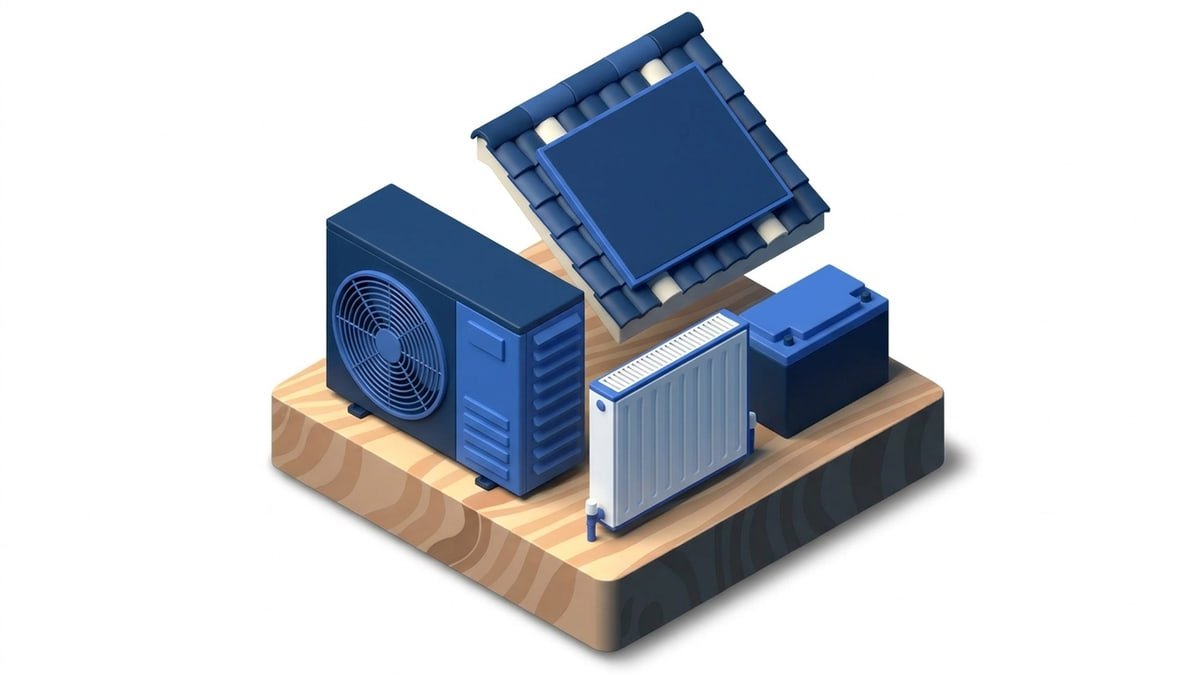
Anyone who sees their heating oil bill in autumn and thinks about a heat pump quickly gets a whole shopping list: underfloor heating is needed, a PV system on the roof, and ideally a battery storage unit in the basement. In your mind, replacing the heating system turns into rebuilding half the house. The question currently keeps popping up in Austrian forums, often with a resigned undertone: Nobody can afford that.
The short answer
No, none of the three is mandatory. A heat pump needs a heating system that manages with a low flow temperature, and planning that really knows the house. Underfloor heating makes this easier, PV lowers the electricity bill, and a battery storage unit is almost never the decisive component for the heating.
Underfloor heating: helpful, but not a requirement
A heat pump works more economically the smaller the difference between the temperature of the heat source and that in the heating circuit. Surface heating in the floor or wall requires little flow temperature, which is why they are considered ideal. However, the climate protection initiative klimaaktiv notes that radiators also work, as long as they are not dimensioned too small. Especially in houses that already have central heating with a water circuit, there are many options according to klimaaktiv.
In practice, many existing radiators are designed more generously than would be necessary today. They were calculated for an old boiler with a high flow temperature and for a house that lost more heat back then. If windows have been replaced or the top floor ceiling insulated since then, a significantly lower temperature is often sufficient. Individual radiators that are too small can be specifically replaced with larger ones. That is only a fraction of the effort that a new screed with underfloor heating would mean.
A simple test for the coming winter: gradually lower the flow temperature of the existing heating system on cold days and observe whether all rooms still get warm. This gives the installer an honest starting point.
PV: often makes sense, but not a must
A heat pump runs just as well on electricity from the grid as it does on electricity from your own roof. klimaaktiv points out that the heating runs mainly in winter, but the PV system delivers the most in summer. Operating a heat pump purely with your own solar power is therefore unrealistic in most houses. Calculated over the whole year, however, the system on the roof can generate roughly as much as the heat pump consumes.
The combination works best for hot water, which is also needed in summer. If you have a PV system or are planning one anyway, you should have the heat pump set so that it preferably charges the hot water cylinder during the day. If you don't have one, you can still install a heat pump now and retrofit the roof later.
Battery storage: mostly a minor matter for heating
A home battery shifts solar power from midday to the evening. In summer, this benefits the household; for heating in winter, it is of little use because there is hardly any surplus from the roof then. What a heat pump actually stores is heat: in the hot water cylinder and in the walls and floors of the house itself.
What matters instead
- Have the heating load calculated. The required output depends on the size and insulation condition of the house. As a rough guide, klimaaktiv states 0,12 kW per square metre for an uninsulated old building, and 0,08 kW for a renovated old building. This does not replace a room-by-room calculation by the installer.
- Insulate first, then replace. If both are due, klimaaktiv advises starting with the renovation. Otherwise, the heat pump will be dimensioned for a demand that the house no longer has afterwards, and will run too large and inefficiently.
- Estimate efficiency in advance. With the JAZcalc tool from the Energieinstitut Vorarlberg, you can estimate during the planning stage how efficiently a system will work in your own house. Our heat pump calculator shows you the magnitude of the running costs.
- Check public subsidies. The federal grant is exhausted for this year, but several federal states are continuing to provide public subsidies. The subsidy check shows what applies to you.
Our first assessment
The list of underfloor heating, PV and storage describes the ideal new build rather than a requirement. In existing buildings, honest planning is what counts: heating load, flow temperature, radiators. Where the radiators are sufficient, the heat pump works without major alterations. Where they are not enough, replacing individual radiators is usually the cheaper way. And where the house simply loses too much heat, insulation is the first step, no matter what is used for heating afterwards.
If you want to know what is possible in your house, get quotes from installers in your region via our request for quotes and ask them to show you the heating load calculation.
AO
This article contextualises a topic that many people are currently talking about. It reflects our assessment and is not a news report. We will continue to think about the topic and update the article if anything new arises.
Sources
- klimaaktiv: Wärmepumpe – Topprodukte und Ratgeber — accessed on 1 October 2026
- Energieinstitut Vorarlberg: Die Wärmepumpe (JAZcalc) — accessed on 1 October 2026
- Sanierungsoffensive des Bundes (federal refurbishment initiative) — accessed on 1 October 2026
We state facts in our own words and link to the source. The mentioned authority itself is always legally binding — public subsidy conditions can change at short notice.