
Ground collector or ring trench collector: what suits a brine heat pump
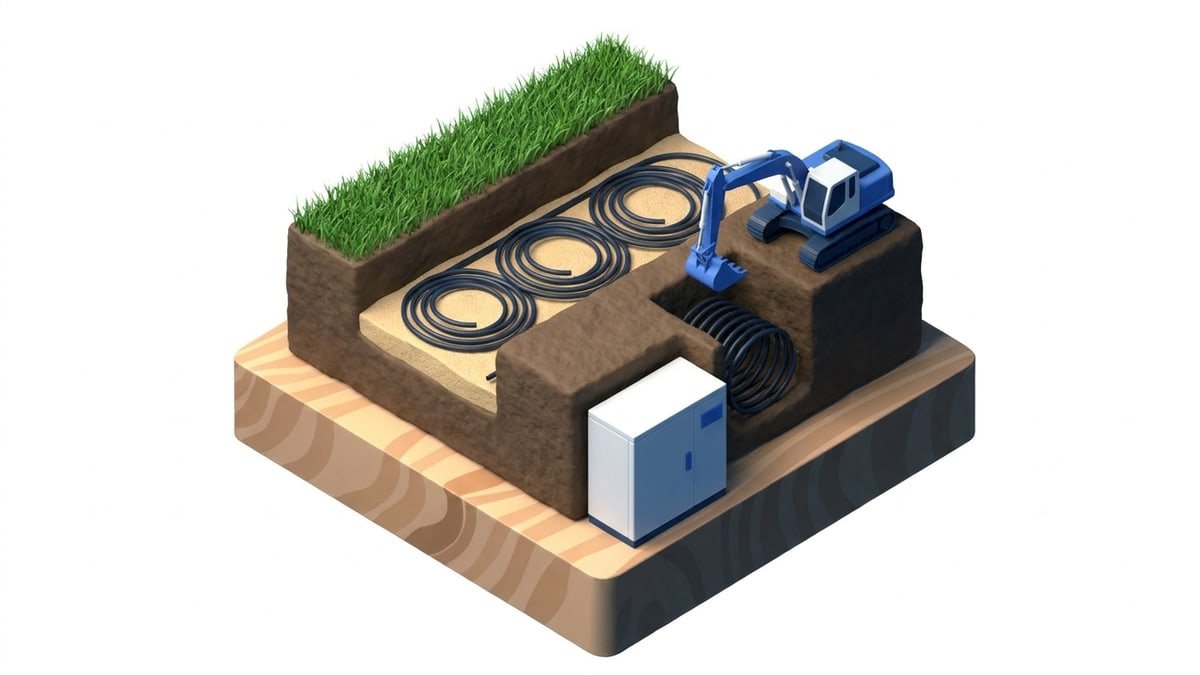
Anyone planning a brine heat pump who doesn't want deep drilling soon faces a choice: a flat-laid ground collector in the garden or a ring trench around the house? As the heating season begins, this question comes up frequently, usually alongside concerns about whether the brine gets too cold in late winter. Our first assessment up front: both options work if they are calculated rather than estimated. A well-sized brine heat pump is one of the most reliable heating systems you can get for your home, and it doesn't need an outdoor unit.
The short answer
Both designs use the top layer of soil, which continually receives heat from the sun and precipitation. The classic flat collector lies in loops under a larger garden area, which must then remain unbuilt. With a ring trench, the pipes are laid in a narrower but deeper trench that runs fully or partially around the house. This saves space, but requires careful planning so that enough soil is tapped and the loops don't steal heat from each other.
Which solution is better depends on your plot: soil type and moisture, available space, accessibility for the excavator and, above all, the heating load of your house.
What sizing is based on
The decisive factor is the extraction capacity, i.e. how much heat is extracted from the ground per metre of pipe or per square metre of collector. The federal state of Upper Austria specifies the calculation method in its form for flat collectors: heating capacity of the heat pump minus its electrical power input, divided by the total pipe length or collector area. The state refers to ÖWAV-Regelblatt 207 (ÖWAV rule sheet 207) as the state of the art for dimensioning. In addition, laying distance, laying depth, annual operating time and an operating point such as B0/W35 are requested. Added to this is a speed limit for the heat pump, which is fixed during commissioning.
The reason for this care: if the heat pump extracts more from the ground over the winter than is replenished, the brine temperature drops week by week. Efficiency decreases, and in the worst-case scenario, the soil around the pipes freezes. A rule of thumb based on living area does not replace this calculation.
When the authority has a say
Under Section 31c (5) of the Wasserrechtsgesetz (Water Rights Act), geothermal systems in areas specially protected under water law (protection and conservation zones) as well as in built-up residential areas without a central drinking water supply must be notified. If the authority does not initiate an approval procedure within three months, the system is deemed approved. It is then valid for 25 years, starting from the day you submitted the notification.
Outside these areas, according to the federal state of Lower Austria, a ground collector does not require approval under water law. A site is considered a built-up residential area without central supply if there are at least ten drinking water wells or springs within a 150-metre radius. Upper Austria rejects flat collectors in water protection zones I and II, as well as close to drinking water wells if impairment is to be expected. It is best to clarify this before starting planning: the Wasserbuch (water register) at the Bezirkshauptmannschaft (district administrative authority) provides information.
Rules that count during construction
The catalogue of conditions from Upper Austria is a good checklist even if your project does not require notification:
- Lay pipes in a sand bed and do not build over the area.
- At least 1 metre clearance to pipes, structures and property boundaries, at least 3 metres to wells.
- A warning tape roughly 50 centimetres below the surface across the entire installation area.
- A pressure test with a record prior to filling.
- A heat transfer fluid in water hazard class 1.
- Keep a site plan with dimensions and construction photos.
Especially with a ring trench close to the house, you should explicitly discuss the clearance to the building and future excavations, for instance for drainage or utility lines, with the installer.
What you can do specifically
- Have the heating load calculated. Without it, any collector size is guesswork.
- Clarify the soil type, for example via excavation, a soil survey or experience from the neighbourhood.
- Check the Wasserbuch (water register) to see if your plot lies in a protection or conservation zone.
- Demand from the installer the calculated extraction capacity including operating point and a justification for the area or trench length.
- Have the installation documented so that future construction work does not hit the pipes.
Our heat pump calculator gives you an initial overview of costs and consumption. If you want to obtain quotes for a brine heat pump, you can do so via our request for quotes.
AO
This article contextualises a topic that many people are currently talking about. It reflects our assessment and is not a news report. We will continue to think about the topic and update the article if anything new arises.
Sources
- RIS: Wasserrechtsgesetz 1959 (Water Rights Act 1959), § 31c — accessed on 15 October 2026
- Federal State of Upper Austria: form Erdwärmeanlage mit Flachkollektor (geothermal system with flat collector, UWD-WW/E-9a), as of April 2025 — accessed on 15 October 2026
- Federal State of Upper Austria: Merkblatt Flachkollektor (information sheet on flat collectors) — accessed on 15 October 2026
- Federal State of Lower Austria: Anlagen zur Nutzung der Erdwärme und der Wärme der Gewässer (systems for utilising geothermal energy and heat from bodies of water) — accessed on 15 October 2026
We state facts in our own words and link to the source. The mentioned authority itself is always legally binding — public subsidy conditions can change at short notice.